By Brian Boyd
More to it – Some foreign Interference – Background Notes
1963
On Thursday 21st of March that year, at a special conference of the ALP at Hotel Kingston Canberra, media reportage alleged “36 faceless men” were determining a policy to undermine the then Menzies government’s decision to allow the US to set up a major military base at North West Cape W.A.
1966
December; Australian Prime Minister Harold Holt signs a ten year lease agreement (1966-76) for the setting up of the proposed CIA base at Pine Gap.
The US North West Cape base, in far North Western Australia, is also in the final stages of development, under a separate agreement. At its opening shortly after, the then US ambassador to Australia, laughing, presents a ‘peppercorn’ for the agreed rent to the federal government!
1967
Harold Holt, as Prime Minister, makes the comment: “All the way with L B J”, a reference to the then US president. This has been described by some commentators over the years, as “perhaps the most cringe worthy statement ever made by an Australian political leader”.
1970
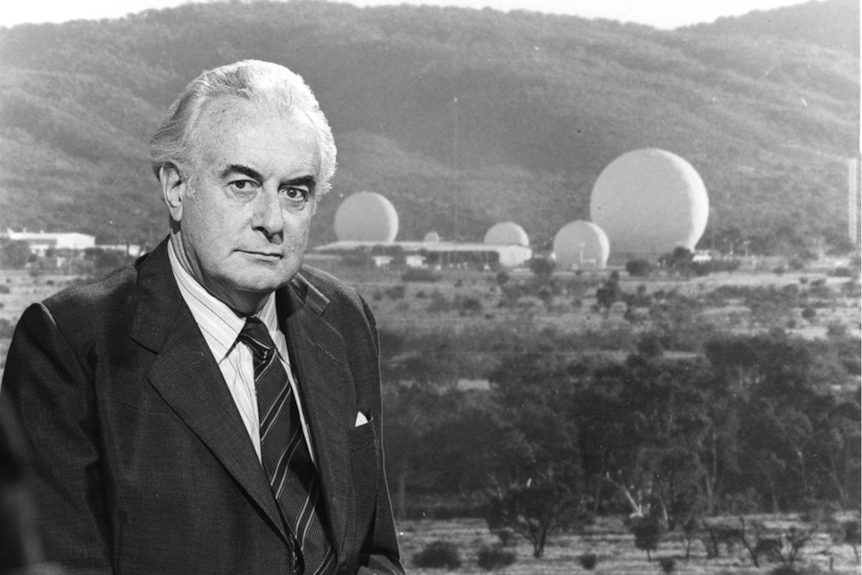
The secret, military US base is now fully operational in central Australia adjacent Alice Springs-Pine Gap. Commentary from the federal government to the Australian people is virtually non-existent.
1972
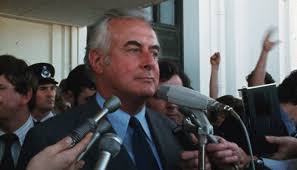
Gough Whitlam makes ‘a public denunciation of the US Christmas bombings in Vietnam’. This raises extreme anger in the US Nixon administration in Washington.
1973
Marshall Green is appointed U S ambassador to Australia. Around the anti-war, trade union and peace movements, Green’s reputation is discussed widely.
For example his ‘presence’ during the 1961 coup in South Korea and his ‘presence’ during the overthrow of Indonesian President Sukarno in 1965, that led to the deaths of up to a million people in subsequent years, is widely canvassed.
ALP Senator Bill Brown, at the time, went public to call Green a “U S hatchet man” sent to Australia to protect “American financial interests and the maintenance of its military installations in this country”.
January (8) Whitlam met with United States ambassador Walter Rice, who had been sent to protest Whitlam’s recent letter to Nixon over the Vietnam War. It is reported that Whitlam stressed he supported ANZUS and did not propose to change defence facilities at Pine Gap, Woomera or North West Cape, but added ‘rather acidly, if the US attempted to screw us, then the facilities would be ‘a matter of contention’. [!]
July (mid) a US defence Department dossier was leaked at the Labor Party conference. It exposed that satellites controlled through Pine Gap and Narrungar, were used to pinpoint targets for American bombings of Cambodia at the time.
July (30) Whitlam meets US president Nixon, Vice President Spiro Agnew, Secretary of State William Rogers and national security adviser Henry Kissinger. The U S ambassador to Australia, Marshall Green, had organised a meeting on the basis that the US had to get along with its allies like Australia, especially since US defence installations were ‘too important to put at risk’.
[Subsequent expose`s of memos and recordings between Kissinger and Nixon have revealed details of ‘sharp, critical assessments’ that both men had of Whitlam at the time.]
1974
January: Australian Deputy Prime Minister and defence Minister Lance Barnard meets US Vice President Ford. Also present were Australian ambassador to the US James Plimsoll, US ambassador to Australia Marshall Green, and senior Australian bureaucrat Arthur Tange. It is revealed that the Americans thought Whitlam was prone to ‘ill-considered remarks’ from time to time. A State Department briefing paper from early 1974 concerned ‘extreme left elements’ within the Australian government, could lead to problems in the US-Australian relations. There was apparent particular concern about ministers Jim Cairns, Lionel Murphy and Tom Uren.
At the Barnard-Ford meeting the Australian Deputy Prime Minister said he and Whitlam could be relied on to defend the existence of US bases in Australia ‘strongly’. The record of the meeting reports that Barnard told the US Vice President that he would defend the US installations in Australia against attacks from ministers, unionists and party figures…
April: (3rd) Whitlam in federal parliament said: “The Australian government takes the attitude that there should not be foreign military bases, stations, installations in Australia. We honour agreements covering existing stations. We do not favour the extension or prolongation of those existing ones”.
[Note: The Pine Gap agreement was up for renewal in 1976].
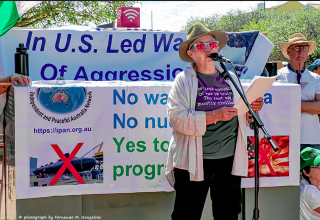
May: A large nationally organised demonstration occurs outside the secret US North West Cape base in Western Australia.
At the protest a peppercorn is thrown over the front gate of the base, with speakers claiming that the 1960’s agreement was now “null and void”.
June: A confidential review of the Australian-US relationship, initiated by US President Richard Nixon in mid – 1974 entitled a “National Security Study Memorandum”, required American national security agencies to explore options for re-locating US intelligence installations, including Pine Gap, outside Australia…”.
August: Some documents from that time, now in the Gerald Ford presidential library, reveal that the “US National Security Council’s Senior Review Group”, took a close look at events in Australia from August 1974. It is clear from the report entitled: The National Security Study Memorandum 204 (NSSM 204), that the US was very concerned about losing control of the Pine Gap base.[To this day researchers have revealed that all documents relating to this issue, in the Gerald Ford presidential library, are still not available.]
1975
While the Whitlam government and the Fraser opposition were locked in the manufactured contest over supply, generating daily headlines, the security relationship between Australia and the US again emerged on the sidelines.
November (2) Whitlam speaking at a public meeting in South Australia claimed that the leader of the Country Party Doug Anthony had close links with the CIA, through knowing the US head of Pine Gap.
November (5-6) Anthony asks Whitlam in Parliament to provide evidence that the head of Pine Gap, Richard Stallings, was a CIA agent.
November (8-9) a draft response was prepared for Whitlam that confirmed in fact that Stallings worked for the CIA. The implications of course was that Pine Gap was not simply a ‘joint’ defence installation, but a CIA-run facility. It is reported that Arthur Tange Secretary of the Department of defence urged Whitlam not to reveal this link, Whitlam was warned that this could risk ANZUS. Whitlam was due to give his answer to Anthony on the afternoon of the 11th of November.
[Only a few days earlier Arthur Tange and Australian defence Department chief scientist Doctor John Farrands co-signed a letter to Whitlam, telling him not to reveal Stallings association with the CIA, thereby linking that secret intelligence body’s association with Pine Gap. In addition, three days before the undermining of the Whitlam administration, a senior Australian defence official had briefed Governor General Kerr, that allegations concerning the CIA in public “was jeopardising” the security of US bases in Australia. These two events were only revealed by Brian Toohey and the Financial Review in April and May of 1977.]
November (10th) Senior CIA officer Ted Shackleton briefed ASIO’s US liaison officer, who followed up with a cable to ASIO headquarters in Australia. It has subsequently been reported that the cables’ contents concerned the CIA fearing the public debate started by Whitlam, threatened to “blow the lid off” US bases in Australia, notably Pine Gap.
[The next day the Whitlam government is sacked by Kerr.]
1976
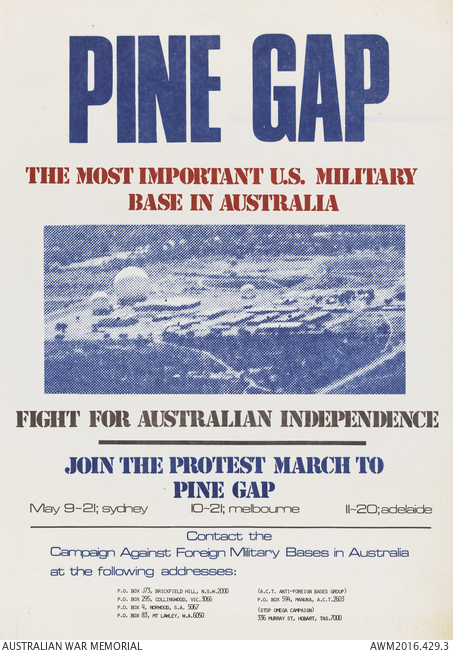
May: A large protest demonstration occurs outside the Pine Gap base near Alice Springs. The key demand of the protest is that the lease with the US, concerning the base, was about to expire, not be renewed.
The Fraser government renews the lease.
1977
July US president Jimmy Carter’s envoy, Warren Christopher, meets Gough Whitlam at Sydney airport.
Christopher, the Deputy Secretary of State, tells Whitlam that President Carter had instructed him to say that: “The [US] Democratic Party and the ALP were fraternal parties. He respected deeply the democratic rights of the allies of the United States. The US administration would never again interfere in the domestic political processes of Australia. He would work with whatever government the people of Australia elected.”
1983
November 10th to the 25th: A large women’s protest camp is set up outside the Pine Gap main gate. Over one hundred arrests made during the protest. A key demand is that the lease for Pine Gap is not renewed.
The federal ALP Hawke government renews the lease.
2011
The federal Gillard/Rudd ALP government embraces the US’s declared ‘pivot to Asia’ policy, under the Obama administration. Without any major public consultations the northern part of Australia is to see 2,500 US military personnel and US military aircraft (including B-52 and Stealth bombers) rotated through the top end. In addition Australian naval bases are opened up for use by US nuclear submarines.
[The American military footprint is expanded exponentially over the following fifteen years. Many millions of dollars are being spent on upgrading airfields and navy bases for US military use].
2025
November. Australian Prime Minister Anthony Albanese makes public comment on the 50th anniversary of the events of the 11/11/75.
Amongst other things he suggests the removal of the Whitlam government was “a calculated plot hatched by conservative forces”. There were “various schemes and sub- plots”. He does not offer any information on who or what actually constituted these ‘forces’, ‘schemes’ and ’sub- plots’.
He then goes on to suggest that there are lessons to be learnt out of what happened to Whitlam. For example on the issue of running a country, he says: “do it in an orderly way” and “do not ignore warning signs”.
One can only assume that Albanese’s key lesson from 1975 is ‘don’t rub up the Americans the wrong way’!
AUSTRALIA AND THE GLOBAL DYNAMIC
Today the global power balance between the main great power blocs – US, China, E U, Russia and Britain are generating a “re-alignment”, a “re-set” of their respective economic interests. Between the superpowers, US and China, there is great economic and therefore, strategic tensions. This is impacting on their respective spheres of influence and spilling over into the spheres of influence of the other economic power blocs.
Within the US superpower there is a political struggle about how the US imperialist empire will position itself, going forward into the rest of the 21st-century. It is claimed by many commentators in the US that the US has had “a loss of standing” globally, especially concerning China and its “emergence as an economic power”.
It is now widely recognised that the US is excercising a process to revamp “how the world works”, with its strategic rivalry with China being described as “the main game in town”. US hard-liners and their Australian counterparts, often described as “war hawks”, are deeming China as an “existential threat” to America’s historical international role. Economic battle fronts are driving transformational geopolitical consequences in a number of ‘hotspots’ around the world. The Middle East, Ukraine, South China Sea, Venezuela, Panama and Syria, for example, all have one thing in common; spheres of influence are being challenged.
More seriously still, there is regular speculation about the possibility of open military conflict occurring between the US and China.
The consequences for Australia, if this was to occur, are profound.
Federal government’s statements in recent years, give little comfort to the Australian public. The government’s position for our region is to support a balance of power, “where no country dominates and no country is dominated”. At the same time we are told we are living in “the most dangerous strategic circumstances since World War II”.
At no time is the public given specific evidence of the nature of the threats that the Australian mainland faces.
In mid – 2025 Prime Minister Albanese made much of celebrating World War II Prime Minister John Curtin’s defiance of London and Washington when he ordered the bringing back of Australian troops from other theatres of war, when Australia faced possible invasion by Japanese forces.
One commentator pointed out the stark contradiction between Curtin’s stance then, and the position of the current government now: “…while the Albanese government has continued to erode the same Australian sovereignty by its blind extension of the American military footprint on our continent, which now includes the stationing of nuclear-armed B52 bombers in the Northern Territory…” (James Curran, A F R, 14/7/25).
Another commentator at the same time suggested: “… In Washington eyes, Australia is an aircraft carrier moonlighting as a continent”.
Both Australian and Chinese officials regularly make public comment about how close and pragmatic the relationship is between the two countries. China in particular talks up the importance of the Australia-China relationship. It is reported the Australian government has high level and regular dialogue with China on both trade and security matters. It was recently revealed that China and Australia have improved communications between the Australian Defence Force and China’s People’s Liberation Army.
Conversely a number of US politicians over the years have openly declared that Australia has become “the central base of operations” for America’s military to deter China in the Indo-Pacific.
Key Questions
Paradoxically this American view of Australia raises a key question for our politicians in Canberra to ask China; If a hot war breaks out between it and the US, will the US military assets on Australian soil become military targets for the People’s Liberation Army?
The Australian people are entitled to know the answer and in turn be given time to insist our national government formulate a foreign policy and defence strategy response, based on genuine national interest and protection of our continent.
US Interference Worldwide
A book documenting “the evils of US global interventionism” listed historically such events, especially by the CIA, since WW11. It came out in 2006 and attracted a ‘media storm” at the time. It was entitled: ROGUE STATE, by William Blum, published by Zed Books Ltd London.
Besides the instigated coups in Chile, Ghana, Greece and many others, Australia gets two mentions:
P186 AUSTRALIA 1972-75 – “The CIA channeled millions of dollars to the Labor Party’s opposition, but failed to block Labor’s election. When the party took power in 1972, it immediately rankled Washington by calling home Australian military personnel from Vietnam and denouncing US bombing of Hanoi, among other actions against the war. The government also displayed less than customary reverence for the intelligence and national security games so dear to the heart of the CIA. Edward Gough Whitlam, the new prime minister, was slowly but surely sealing his fate. Through complex supra-legal maneuvering, the US, the British and the Australian opposition were eventually able to induce Governor-General John Kerr-who had a long history of involvement with CIA fronts – to “legally” dismiss Whitlam in 1975.”
P228 AUSTRALIA 1974-75- “Despite providing considerable support for the opposition, the United States failed to defeat the Labor Party, which was strongly against the US war in Vietnam and CIA meddling in Australia. The CIA then used “legal” methods to unseat the man who won the election.”
Final Comment
The lessons of 1975 continue to have much relevance today. It is a key reference point of many in how our country has developed and is continuing to develop, as we go into the rest of the 21st-century.
With the US embedding itself ever increasingly into our country’s military, economy and cultural identity, the struggle for real, genuine and independent national sovereignty, has a long way to go.
March 2026.
Reference Material
- Troy Bramston, ‘Gough Whitlam – the vista of the new’, 2025.
- Malcolm Fraser, ‘The political memoirs’, 2010.
- Malcolm Fraser, ‘Dangerous Allies’, 2014.
- Caiden Bartholomew, ‘Pine Gap on red alert-parts 1 and 2, 6/5-13/5, 2024.
- Denis Freney, ‘The CIA’s Australian connection’, 1977.
- Tom Gilling, ‘Project Rainfall-The secret history of Pine Gap’, 2019.