By Brian Boyd
Introduction
The shock to Australia’s body politic in 1975, was a blow to the nation’s national sovereignty. The unprecedented sacking of the ALP Whitlam government by Governor-General Kerr and the installation of Liberal leader Fraser as interim Prime Minister, caused wide spread opposition. Large demonstrations occurred immediately. Numerous protests continued, even after the 1976 federal election result.
The specific event of November 11th 1975 opened up wider analysis of the ‘schemes’ and ‘sub-plots’ that lay behind the overthrow. In many quarters the spectre of foreign interference, particularly by the US, was canvassed. Such involvement in Australian affairs shows that 1975 was just one of a number of focal points, where Australia’s self-respect has been compromised over a long period of time.
Revisiting 1975 gives rise to the continuing need in modern times to reflect on the nations’ independent status in the 21st Century.
Recollections, Commentary and Background
The John Kerr/Malcolm Fraser undermining of the A. L. P. Whitlam federal government in 1975, was a ‘transformational’ event in Australia’s political history.
When the drama of 11th November that year occurred, there as an immediate public response.
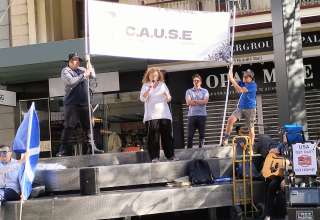
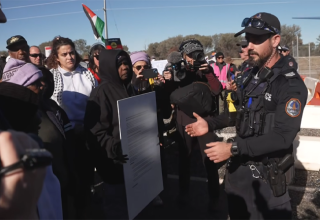
At the time, many of us were members of the Students for Australian Independence (S A I), a subset of the broader Australian Independence Movement (A I M). The reaction was immediate to the news out of Canberra of the sacking of the government. Many hundreds of us, from Latrobe University, Monash University, Melbourne University and other campuses, converged on Melbourne’s city square, to protest.
By the next day thousands of people were in Melbourne’s C B D city streets, over Kerr’s blatantly, political intervention. Over the next few days and for a number of weeks, many protests and marches occurred, in Victoria and interstate. The public reaction in opposition grew to the unprecedented removal of an elected government. Progressive unions, such as the B L F, BWIU, Waterside workers Federation, Plumbers Union, Miscellaneous Workers Union and the suburban based network of ALP branches, helped grow the angry response to what was quickly deemed a ‘semi-coup’, against Australia’s democratic framework.
[The description ‘semi-coup’ was purposefully used, as it followed on from the shock of the full-blown military, CIA backed coup in Chile, which occurred only two years earlier.]
At each and subsequent rally, the radical student/trade union and wider public alliance called for an ongoing, sustained protest campaign to continue. Whitlam’s call to ‘maintain the rage’ was accepted as a battle cry.
More To It
From the start, a key aspect of the protest campaigns narrative, was to strongly suggest that the actions of the governor-general had a lot more to do with issues well beyond the conservative side of parliamentary politics, holding up the federal budget. Their tenuous hold on the numbers in the Senate was not sustainable.
During Whitlam’s second term there were revelations about the role of the US secret base at Pine Gap in Australia and its connections with some conservative politicians. Plans by the then national resources Minister to nationalise Australia’s emerging natural resources, rather than them being exploited by multinational companies and the Attorney-General Murphy raid on ASIO, also drew the ire of the monopoly mass media.
Immediately on taking office in December 1972, Whitlam attracted sharp criticism from the U S Nixon administration over his opposition to the carpet bombing’ in Vietnam and his opposition to the war in general. One of his first acts was to abolish conscription.
In a short period of time, the Whitlam government had also introduced major social reforms such as universal health care, free tertiary education, modernised family law and the promotion of a more viable Australian film industry.
It was a relatively progressive time in Australian politics, after many decades of Liberal/National party rule. The CIA director William Colby, well before November 1975, went public in the US to suggest a potential trouble spot facing the US was “a left-wing and possibly antagonistic government in Australia”.
Protest organisers also made much of John Kerr’s conservative background, including links to CIA funded cultural organisations.
The imposed interim Prime Minister, Malcolm Fraser, quickly called for a new federal election for 13 December 1975. Shortly after Bob Hawke, then a leader at the ACTU and a senior figure in the Australian Labor Party, went public and called for an end to the growing protest movement, insisting all effort should be re-directed to the upcoming election campaign.
Hawke went further and appeared in the media shaking hands with Malcolm Fraser and stating the upcoming election was the best way forward. This intervention didn’t totally dent protest action but it curtailed the growing of any wider public protest movement, for a time.
The monopoly mass media used Hawke’s ‘blink’ to enhance its smear campaign against Whitlam and opposed his return to office. It exaggerated the so-called ‘chaos’ of his government’s period in office, especially since being re-elected in 1974.
Fraser won, Whitlam lost.
Protests Continued
Regardless, progressive forces from within the union movement, universities and the wider community, continued to mobilise protest action wherever possible. In many quarters the seriousness of what had happened on the 11th of November 1975 was never forgotten.
In May 1976 busloads of protesters went to the US secret base Pine Gap, near Alice Springs, to highlight its importance to the US global war machine.
In August 1976 Malcolm Fraser was locked into a building at Monash University by thousands of students for over twelve hours (see the 2023 film by Gary Newman: “How to Capture a Prime Minister”). The Fraser government had made cuts to education funding, adding to its unpopularity on campus.
When the Fraser government went after Whitlam’s universal health care initiative, Medibank, protest activities increased.
During one major union protest against Fraser’s attack on Medibank, a breakaway march went to Bob Hawke’s office at the ACTU. It was trashed, over his unpopular role preceding the 1975 federal election.
Like Fraser, John Kerr also faced protests at many public appearances he made.
At the 1976 Melbourne Cup he was heckled and partially drowned out at the presentation.
When Kerr was invited to speak at a revamped St. Kilda yacht club opening, or at employer, legal and business conferences like those held at Leonda Restaurant Hawthorn, in St Kilda Rd and at the Hilton Hotel in East Melbourne, large protests dogged him.
Often, ASIO was forced to hide Kerr and his wife at the Queens Cottages resort in Khancoban.
In 1977 Fraser defeated Whitlam again at a federal election.
However, by now, Fraser was forced to replace Kerr as governor-general, sending him to a token position at UNESCO in faraway Europe.
At the time, Kerr’s demise was seen as a major win by the protest movement.
In the second term of the Fraser government there was also an accelerated push to change industrial relations legislation. The laws were aimed at curtailing rights of unions and collective bargaining, promoting instead individual contracts and weakening OHS practices.
This triggered more protest activities, especially by unions.
1975 was indeed a pivotal turning point. The political and industrial protests and campaigns arising from that momentous year, came off the back of more than a decade of protest and resistance to the US’s Vietnam War.
It was, however, just another focal point, where Australia’s national sovereignty was compromised by foreign intrigue.
It is worth reviewing some examples of how and when Australia’s national sovereignty and self-respect, has been compromised over the decades. They challenge the key theme promoted by much of the mass media concerning 1975, at the time and over the years, that emphasises it was merely a ‘dismissal’, albeit using opportunistically ‘colonial era’ legalese.
The media and various politicians have tried to confine their proffered analysis to the shallow shenanigans to the personal exchanges of the politicians on the floor of Parliament. Added to this repetitive mix is a minute by minute narrative of what Kerr, Fraser and Whitlam, as individuals, did on the single day of the 11/11/75. These narrow ingredients are sold as the best way to understand what happened.
Much of the wider political milieu is conveniently set aside.