By Richard Stone
Those following the acrimonious immigration controversy between the Australian Liberal Party and One Nation (ON) might like to consider some of the not-so-conspicuous hidden hands pulling strings behind the scenes. The hidden hands also carry some considerable and highly incriminating baggage, in their distant and not-so-distant past; the two periods appear to merge together in one big picture of obscurant figures and connivance.
Australian mainstream media outlets carry a daily barrage of right-wing political controversy about immigration levels. It rests upon Australia’s racist history with the legacy of a Whites Only immigration policy which was also used against Asian people. The fate of Aboriginal people has also been well recorded, with numerous horrific injustices since the time of settlement. It has provided fertile political ground for those seeking to maximise their right-wing credentials without too much consideration for related matters. Cognitive issues also play their part in the wider considerations.
While the Liberals, their coalition allies and ON portray themselves as respectable people, participating in a public debate about Australia, for example, all is not what it necessarily appears; the shadowy participation of those lurking behind the scenes not wishing to openly publicise their role is not, however, particularly difficult to identify.
It has a long and sordid history, linking class and state power with wider issues for their associates. The corridors of power are a dark place for the pooling of hidden agendas.
Australia’s Whites Only immigration policies, for example, evolved from British defence and security concerns about the Indian Ocean; a vast expanse of ocean with sensitive shipping lanes and numerous countries of significance for Whitehall. Australia was strategically placed at one side of the Indian Ocean, Apartheid South Africa at the other.
The Australian Liberal Party of Menzies, remained silent over the issues arising from the injustices of Apartheid and the Whites Only immigration policy. It is still baggage for subsequent generations who prefer the diplomatic silence over credible historical research.
The racist Australian immigration policy was only finally repealed during the years of the Whitlam administrations of 1972-75, which coincided with Australia’s support for the Anti-Apartheid Movement and condemnation of white supremacist regimes at the 1975 Commonwealth Heads of Government Meeting in Kingston, Jamaica. (1)
The high-level diplomatic meeting, of which Australia played a key part, for example, recorded in their official correspondence that, ‘Heads of Government reaffirmed their total and unequivocal condemnation of apartheid and all forms of racialism’. (2) The fact the same meeting also recorded its support for Cuba, which had provided considerable support for the national liberation movements together with support for the Indian Ocean as a Zone of Peace’, was controversial. (3) Diego Garcia, and US intelligence facilities, was an issue.
The fact that Whitlam and his administration were subsequently sacked by the Governor-General a few months later led to conspiracy theories for well over half a century about the real motives of those removing a progressive Labor administration from office in Canberra.
History, nevertheless, moved on; the legacy of the past, however, has bearing on the present.
Following the collapse of Apartheid in South Africa during the mid-1990s, a number of countries experienced the rise of centre-right popularist political parties, focussing upon the immigration issue; Australia was no exception with ON. The popularist parties invariably, however, have proved little other than fronts for other, darker, shadowy political forces. (4) The timing was not coincidental. Other factors, moreover, would appear to play their part.
Tracing the overlapping circles of interest with one prominent figure from the period, Graeme Campbell (1939-2025), for example, has revealed a curious picture of political intrigue; the hidden hands of South Africa have not been difficult to identify.
Campbell, initially a prominent member of the Australian Labor Party, also remained in league with shadowy figures of the far-right. He was eventually expelled from the ALP in 1995, and then subsequently drifted into various front organisations campaigning against immigration including the so-called Australia First party (AF) in 1996, with links to ON. (5) The timing of the Campbell’s expulsion from the ALP was also significant; Apartheid had been pushed into the rubbish-bin of history the previous year. Questions, therefore arise: had he had already served his purpose; or was he merely enticed into new pastures of interest? The AF, furthermore, from its earliest days, was a Trojan horse-type body.
Campbell also retained links with the shadowy Australian League of Rights (ALOR), a body which lurked behind a P.O. Box Number at Morphett Vale in South Australia, while having established formal links with the South African defence and security system. (6) While secrecy was regarded as important in Australia, it was not so significant in South Africa itself. During the previous Cold War, ALOR leader, Eric Butler, for example, was provided with secure employment by the Apartheid government in Pretoria as an official trainer of the Security Police; the government department was primarily concerned with policing subversion, repression and widespread use of torture. (7)
Elsewhere, the hidden hands of the South African intelligence services used well established links in Australia to deflect attention away from the brutality of the Apartheid regime. The so-called Anti-Communist Movement, organised by a shadowy figure based in Britain was noted to have ‘enlisted hundreds of members … in Australia … and … secretly attempted to recruit men willing to fight as full-time soldiers or mercenaries in Angola and Rhodesia’. (8)
Reference to the Anti-Communist Movement is thought to be linked to the World Anti-Communist League (WACL) established in 1966 from the Asian People’s Anti-Communist League, which later evolved in 1990 into the World League for Freedom and Democracy. Studies of the earlier organisation have revealed a ‘preponderance of Taiwanese and Korean military and intelligence officers within its ranks’. (9) Later studies have concluded with a CIA report that ‘the WACL a neo-fascist umbrella organisation that assisted US intelligence operations … during the Reagan years’. (10)
It is important to note that the ALOR was a registered affiliate of the WACL. (11) There was, however, a curious overlap of intrigue with Australia also having representation inside the WACL with ‘Conservative members of parliament … in 1978 one called the international ecology movement … a communist ruse … interspersed with neo-Nazis, racists, and Eastern European immigrants whose roots lay in the fascist collaborationist armies of World War Two’. (12)
The front-type organisations used by South Africa evolved from the notorious Muldergate scandal, which included secret funding of intelligence facilities based in ‘businesses’ to promote the country against sanctions. Their role was essentially to identify adversaries, infiltrate their organisations and disrupt their activities. Subsequent investigations revealed that the Information Department had funded ‘138 secret projects … years later … at least half of those 138 secret projects are still continuing to operate’. (13)
The link between the secret projects and Australia has remained hidden within official classification for well over the standard thirty years, tending to indicate their sensitive nature. They appear likely to remain classified forever. Any questions meet with silence.
It is not particularly difficult, however, to identify connecting links between centres of influence and intrigue, particularly in light of the collapse of Apartheid in the mid-1990s which released huge amounts of illicit finance. Opportunities, for the far-right, were subsequently opened elsewhere.
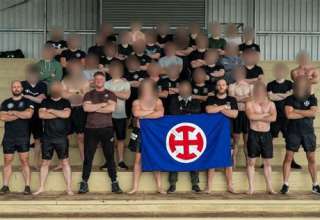
Thirty years after its formation, AF has taken on a new lease of life; it would appear to have promoted some of the recent controversy surrounding immigration in Australia. The party has also concentrates its attention upon pursuing a policy of zero-immigration, and displacement theory amongst its ultra-nationalistic and anti-multiculturalism standpoints. (14) Its advocacy of ‘individual rights’ has carried all the hallmarks of a legacy of the ALOR positions from the previous Cold War. (15) It is not particularly difficult to establish the overlapping circles and common terminology on their official websites; AF would appear to be setting part of the agenda subsequently pursued by the Liberals and ON.
In recent times a leading member of AF has also been identified organising young Asian men and women in a quiet, leafy suburb in Adelaide, South Australia. (16) Whether those young people associated with AF were useful idiots or being manipulated for a covert operation of infiltration, intelligence-gathering and disruption, remains a matter of conjecture. Their far-right legacy of complicity, however, would appear incriminating.
1. See: Commonwealth Heads of Government Meeting in Kingston, Jamaica, 29 April – 6 May 1975
Final Communique, Section 17 – Southern Africa.
2. Ibid., Sub-section 25.
3. Ibid., Sub-section 16, and, Sub-section 13.
4. Scott Morrison signs on with global political network home to ‘intolerant far right’, The New Daily, 18 September 2022, and, Nazis out of uniform, Denis Freney, (Sydney, 1985).
5. Wikipedia: Graeme Campbell.
6. Ted Serong, Anne Blair, (Melbourne, 2002), page 186, and, Contact Details, ALOR.
7. See: Efforts of an Australian anti-red, The Star, (South Africa), 15 July 1967, and, The spy in the newsroom,
Australian Playboy, June 1982, pp. 111-116.
8. Inside BOSS., Gordon Winter, (London, 1981), page 527.
9. Inside the League, Scott Morrison and Jon Lee Anderson, (New York, 1986), pp. 58-59.
10. Right-wing terrorism in Europe: A Research Paper, CIA Directorate of Intelligence Report, April 1983, and, Inside the League, ibid., page 189.
11. Inside the League, ibid., pp. 524-35.
12. Ibid., page 59.
13. No apology for white Australia policy, The Sydney Morning Herald, 12 January 2008, and, Official websites: AF.
14. Ibid., AF.
15. Ibid.
16. Confidential Source.